"It was supposed to have been their time. It was not" - How 60's journalism resounds in 2021.
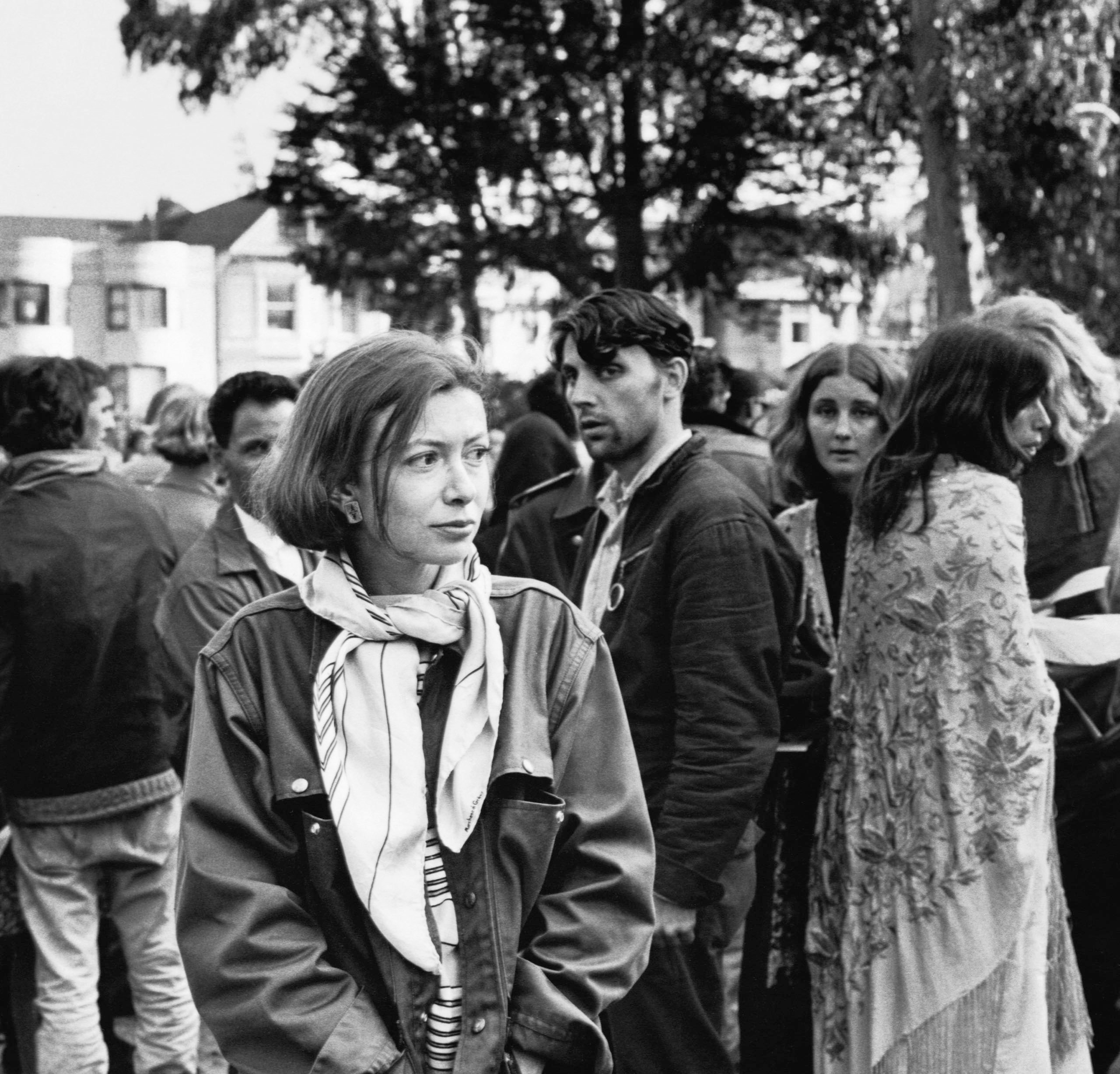 |
| Joan Didion, April 1967 |
"Late one afternoon I sat in the Miramar lobby, watching the rain fall and the steam rise off the heated pool outside and listening to a couple of Jaycees discussing student unrest and whether the “solution” might not lie in on-campus Jaycee groups. I thought about this astonishing notion for a long time. It occurred to me finally that I was listening to a true underground, to the voice of all those who have felt themselves not merely shocked but personally betrayed by recent history. It was supposed to have been their time. It was not."
Above are Joan Didion's words depicting two group members' acknowledgement of social justice's potential solutions not necessarily lying within the activity of the Jaycees convention they'd recently attended. The intellectual phenomenon was astonished by their notion; a possibility that perhaps it is not those who are 'shouting the loudest' who most desparately seek social remedies. Didion goes on to regard their perspectives as truly 'underground' and part of a community of young people that feel betrayed by recent history. "It was supposed to be their time. it was not" remains poignant today.
This timeless statement ideally summarises the youth of the 21st Century and how all control of their future's have been relinquished amongst a sea of continual systemic social unjust, a pandemic and a planet in peril. Today's sensationalist media outlets (with assistance from the insufferable click bait phenomenon) will persist in diluting the struggles of the remaining authentic activists who aren't quote on quote "saving the world via cellphone".
This functions as a reminder for us as individuals to continually question the authenticity of our daily media sources. How can a modern day western civilisation in crisis remain genuinely democratic (as if to say it ever has been)? Take the tragic death of George Floyd as an example - journalists held an astonishing amount of power when it came to driving the narrative of the George Floyd demonstrations. Some would argue the protests to have been a 'hinderance' to the all important investigative process, others would highlight the lack of such media storms surrounding other serious cases of police brutality such as that of Dreasjon Reed or Breonna Taylor.
Last week, Australia's news sources were temporarily banned from Facebook. This was the top social media platform's retaliation to the Australian government in relation to demands of payment for news sources. A dangerous news vacuum formed during this short period, one that could of lead to masses of misinformation and/or lack of important safety details with regards to the coronavirus pandemic. Whilst essential Australian news sources have now been restored, such discrepancy further proves the overriding power of modern technological advancements (social media, tech companies, the media) over our right to formulate individual schools of thought.
How can we revolutionise the world or thought if it is only to be fed into this digital echo chamber? How can we find solutions in a society famous for illegitemizing problems? How could it ever be 'our time' when our identities were formulated for us the moment we logged in?


Comments
Post a Comment